
- October 1, 2026
- Posted by: manager
- Category: blog
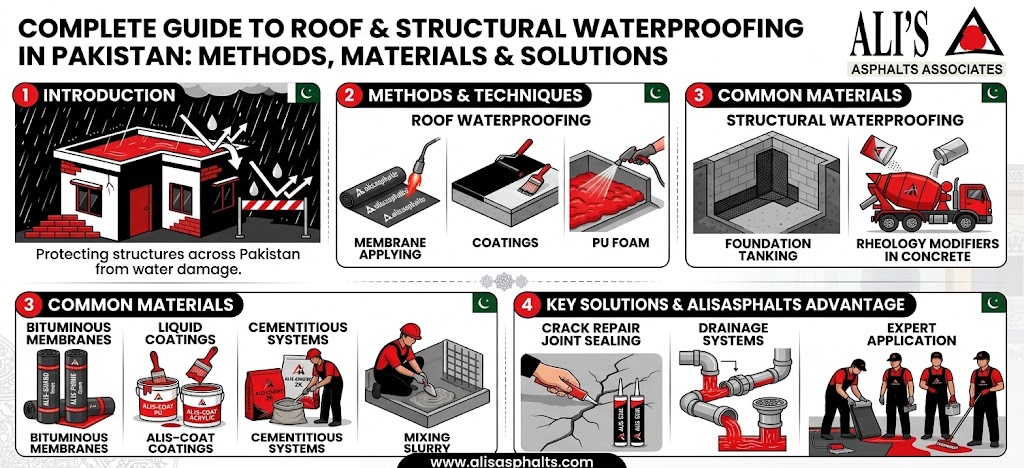
Every year, the same cycle repeats across pakistan: monsoon rains hammer rooftops for a few weeks, then a brutal summer sun pushes surface temperatures past 45°C for months on end. Concrete does not handle this swing well. RCC (Reinforced Cement Concrete) slabs expand under heat, contract in cooler nights, and absorb moisture during rain — and over a few years, this cycle opens hairline cracks that grow into full-blown seepage points.
What starts as a small damp patch on a bedroom ceiling is rarely just cosmetic. Left untreated, water finds its way to the reinforcement steel inside the slab, causing corrosion, spalling, and long-term structural decay — the kind of damage that costs thousands to repair. This guide breaks down exactly why Pakistani buildings leak, which waterproofing method fits which situation, and how to get the job done right the first time — whether you’re hiring a contractor or evaluating one’s proposal.
Common Water Leakage Causes in Pakistani Buildings
Before picking a waterproofing chemical or membrane, it’s worth understanding why Pakistani rooftops and walls leak in the first place. Local construction practices, climate, and material quality all play a role.
Poor Roof Slope (Dhalan)
Every RCC roof needs a slight gradient — locally called Dhalan — sloping toward the drainage outlets. When mistrees (masons) skip proper slope calculation during casting, water pools instead of draining. Standing water increases hydrostatic pressure on the surface, and even a good coating will fail faster under constant ponding than under normal rainfall runoff.
Blocked or Poorly Placed Khurras
The Khurra is the drainage outlet chamber on a rooftop — usually a small sunken box that channels water into the down-pipe. If it’s positioned at the wrong point relative to the slope, or gets blocked by debris, leaves, or poor construction, water backs up around the opening and seeps through the slab-to-pipe joint. This is one of the most common leak points inspectors find during monsoon season.
Shrinkage Cracks in RCC Slabs
As concrete cures and ages, it shrinks slightly. Combined with thermal cracks caused by 45°C+ summer expansion and contraction during cooler months, this creates a network of hairline cracks across the slab surface. Individually these cracks look harmless, but under monsoon rainfall they act like capillary channels, pulling water straight through to the ceiling below.
Joint Failures in Precast Slabs
Many mid-range and older constructions use precast slab systems instead of fully monolithic RCC pours. These slabs are cost-effective and fast to install, but the joints between precast panels are inherent weak points. Without proper joint sealing using PU sealant or a reinforced membrane, water finds a direct path through these seams during heavy rain.
Rising Dampness (Seelan) vs. Wall Efflorescence (Shora)
These two terms get confused constantly by homeowners, but they describe different problems:
- Seelan/Silan (Rising Dampness): Moisture that travels upward through a wall via capillary action, usually from ground contact, a leaking pipe, or a poorly waterproofed roof above. It shows up as a damp patch that darkens the paint, often with a musty smell, and tends to worsen during humid months.
- Shora (Efflorescence): A white, powdery, salt-like crust that forms on brick or plaster surfaces when water evaporates and leaves behind dissolved mineral salts (mainly calcium and sodium sulphates) from the brick or cement. Shora is a symptom of moisture movement through the wall, not the moisture itself — treating the white crust without fixing the underlying seepage source means it will keep coming back.
Understanding which of these is happening — and where the water is actually entering — determines whether you need roof-level waterproofing, damp-proofing at the wall base, or both.
Common Waterproofing Methods Used in Pakistan
There are many waterproofing method — the right choice depends on the surface, budget, exposure to foot traffic, and whether heat reduction is also a priority. Here’s how the four major approaches used across Pakistan compare.
Method 1: Bitumen Torch-On Membrane (APP Based)
APP (Atactic Polypropylene) Bitumen membrane is a modified bitumen sheet, torch-applied directly onto a primed surface. It remains the go-to choice for heavy-duty roof protection, especially on flat commercial roofs and rooftops with heavy water tank loads. Brands like Roofgrip considered as market leader.
Method 2: Cementitious 2-Component (2K) Waterproofing Slurry
A 2K cementitious slurry combines a cement-based powder with a polymer liquid (often with an SBR bonding agent) to form a rigid but crack-bridging waterproof coat. Brands like Radiant offers widely used 2K systems in the Pakistani market.
Area-Specific Waterproofing Breakdown
Different parts of a building demand different waterproofing approaches. Applying a one-size-fits-all treatment across a whole property is one of the most common (and costly) mistakes homeowners make.
1. Roofs & Terraces
Roof waterproofing starts with surface preparation and grinding to remove loose debris, old flaking paint, and laitance from the concrete surface. Special attention goes to the Pardi (parapet wall) and Gola (the chamfered junction where the wall meets the roof) — these transition points are where most leaks originate because they experience the most structural movement. Filling and reinforcing Gola joints with mesh tape embedded in a flexible joint sealant or membrane strip is a non-negotiable step, not an optional extra.
2. Underground & Overhead Water Tanks
Water storage tanks need a different standard entirely: non-toxic, food-grade cementitious coatings that won’t leach chemicals into drinking water. Both underground tanks (which face external ground moisture pressure) and overhead tanks (which face constant internal water pressure and UV exposure) need coatings specifically certified as potable-water-safe. Cutting corners here — using a standard exterior coating instead of a certified tank-grade product — is a health risk, not just a maintenance issue.
3. Bathrooms & Kitchens
Wet-area waterproofing happens before tiling, not after — this is called sub-tile waterproofing. A cementitious or PU-based membrane is applied to the floor and up the walls (typically 15–20cm) before tiles go down, with special sealing around the floor trap and shower pan area, since these are the highest-exposure points to standing and running water. Retrofitting waterproofing after tiles are already down is far more expensive and usually requires partial demolition.
4. Basements & Retaining Walls
Basements face a unique challenge: water pressure from the ground pushing into the structure. There are two approaches:
- Positive-side waterproofing: Applied on the side of the wall facing the water source (the exterior, or the “wet side”). More effective since it stops water before it enters the wall material at all, but only possible during construction or major excavation.
- Negative-side waterproofing: Applied on the interior (dry side) of an already-built wall. Common for retrofits where excavating the exterior isn’t practical.
For structures facing a high water table (common in parts of Karachi and low-lying areas), bituminous membrane are often used .
Waterproofing Cost & Rate Estimates in Pakistan
Actual pricing depends on surface condition (a heavily damaged roof needs more prep work and crack repair before coating), total roof area (larger jobs typically bring the per-sq-ft rate down), city-specific labor rates, and the specific brand/product generally sit at a premium compared to local alternatives. Always get an on-site inspection and written quote rather than relying on phone estimates.
Step-by-Step Roof Waterproofing Process (Best Practices for Applicators)
Whether you’re supervising a contractor or handling a small DIY patch job, this is the sequence a properly executed waterproofing project should follow:
Step 1: Deep Surface Cleaning & Grinding
Remove all dust, loose debris, algae, and old flaking coatings using a wire brush, grinder, or pressure wash. Any contamination left on the surface prevents proper adhesion of the primer and top coats — this is the single most skipped step by low-budget applicators, and the most common reason coatings fail within a year.
Step 2: Crack Repair & Gola Creation
Widen and fill visible cracks with a flexible sealant (PU-based sealants work well here since they accommodate thermal movement). Form or repair the Gola at every wall-roof junction, embedding a reinforcing mesh tape into the fillet to bridge the highest-stress point on the whole roof.
Step 3: Primer Application
A compatible primer is applied to the cleaned, dry surface to improve bonding between the concrete substrate and the waterproofing coat or membrane. Skipping the primer — common on rushed jobs — significantly shortens the coating’s service life.
Step 4: Multi-Coat / Membrane Laying (Perpendicular 2-Coat Rule)
For liquid coatings, apply at least two coats with the second coat rolled perpendicular to the first (e.g., north-south, then east-west). This ensures full, even coverage without thin spots or missed patches. For membrane systems, overlaps between sheets should be a minimum of 10cm, fully torched and sealed.
Step 5: Flood Testing (Ponding Test)
Before considering the job complete, the roof should undergo a flood/ponding test: water is held on the surface (usually to a depth of a few inches, blocked at drainage points) for 24–48 hours while the ceiling below is checked for any sign of seepage. This is the only real way to confirm the waterproofing actually works before it’s covered with tiles, gravel, or left exposed — yet it’s frequently skipped by contractors trying to finish quickly.
How to Choose a Reliable Waterproofing Contractor in Pakistan
The waterproofing industry in Pakistan has a wide quality spread — from trained applicators using certified branded systems to informal labor using undiluted, mislabeled chemicals. A short checklist before hiring:
- Warranty period: Reputable contractors typically offer 5–10 year warranties on workmanship and materials. Be wary of anyone unwilling to put a warranty in writing.
- Surface preparation quality: Ask specifically how they plan to clean, grind, and repair the surface before coating — a contractor who jumps straight to “which waterproofing system do you want” without discussing prep is a red flag.
- Brand transparency: A trustworthy contractor names the specific product and brand they’re using (Roofgrip, Radiant etc.) rather than vague terms like “imported chemical.”
- Past project references: Ask for addresses or contacts of previous jobs, ideally ones done 2+ years ago — this shows how the work actually holds up over time, not just how it looks on day one.
Frequently Asked Questions
What is the best waterproofing for roof leakage in Pakistan?
There isn’t a single “best” solutions for every situation — it depends on the roof’s condition and exposure. For roofs with heavy standing water or commercial use, a bitumen torch-on membrane offers the strongest barrier. For most residential rooftops with moderate exposure, an elastomeric acrylic coating from a recognized brand offers a good balance of flexibility, cost, and ease of application.
Can waterproofing stop heat inside the house?
Standard waterproofing primarily block water, not heat, though many do offer some reflectivity. For a meaningful reduction in indoor temperature, look specifically for solar reflective / cool roof coatings, which are formulated with heat-reflective pigments in addition to waterproofing properties.
How do I permanently remove Shora (efflorescence) from brick walls?
Scraping or washing away the white Shora crust only removes the visible symptom — it typically returns because the underlying moisture path hasn’t been fixed. Permanent removal requires identifying and sealing the actual source of water ingress (often a roof leak, a plumbing leak, or rising dampness from the ground), then treating the wall surface with a silane-siloxane sealer or appropriate damp-proofing treatment once the wall has fully dried out.